

Pharmacists described a recurring pattern. While creating or updating rules, they frequently paused to answer questions such as:
Is this medication part of this classification?
Which drugs belong to this category?
What does this code represent?
Are there related medications I should include?
The workflow had become fragmented across the Formulary Management tool, reference websites, internal documentation, and browser searches. Rather than asking, “How can AI answer pharmacists’ questions?” I reframed the challenge:
Discovery included:
Contextual interviews
Workflow observation
Question inventory analysis
Prototype evaluations
Moderated usability testing
Nearly every participant reported leaving the application multiple times during rule creation. An analysis of common questions showed that most interruptions involved drug and classification research:
The most important insight was that pharmacists did not want AI to make clinical decisions for them. They wanted it to eliminate repetitive research. This distinction shaped the product strategy. The assistant would retrieve and organize information, while pharmacists would continue to interpret that information, make decisions, and complete existing review processes.
The pharmacist remains the decision-maker. AI provides supporting information, but users retain responsibility for evaluating and applying it.
Responses should give pharmacists enough context to judge whether information is relevant and reliable. The experience should support verification rather than encourage automatic acceptance.
Preserve workflow context
The assistant should feel like part of the Formulary Management experience rather than a separate destination. It needed to remain available alongside the task without obscuring or interrupting it.
Information should appear where questions naturally occur, allowing pharmacists to continue working without moving between applications or reconstructing their task context.
An integrated AI workspace


Designing Conversations for Clinical Workflows

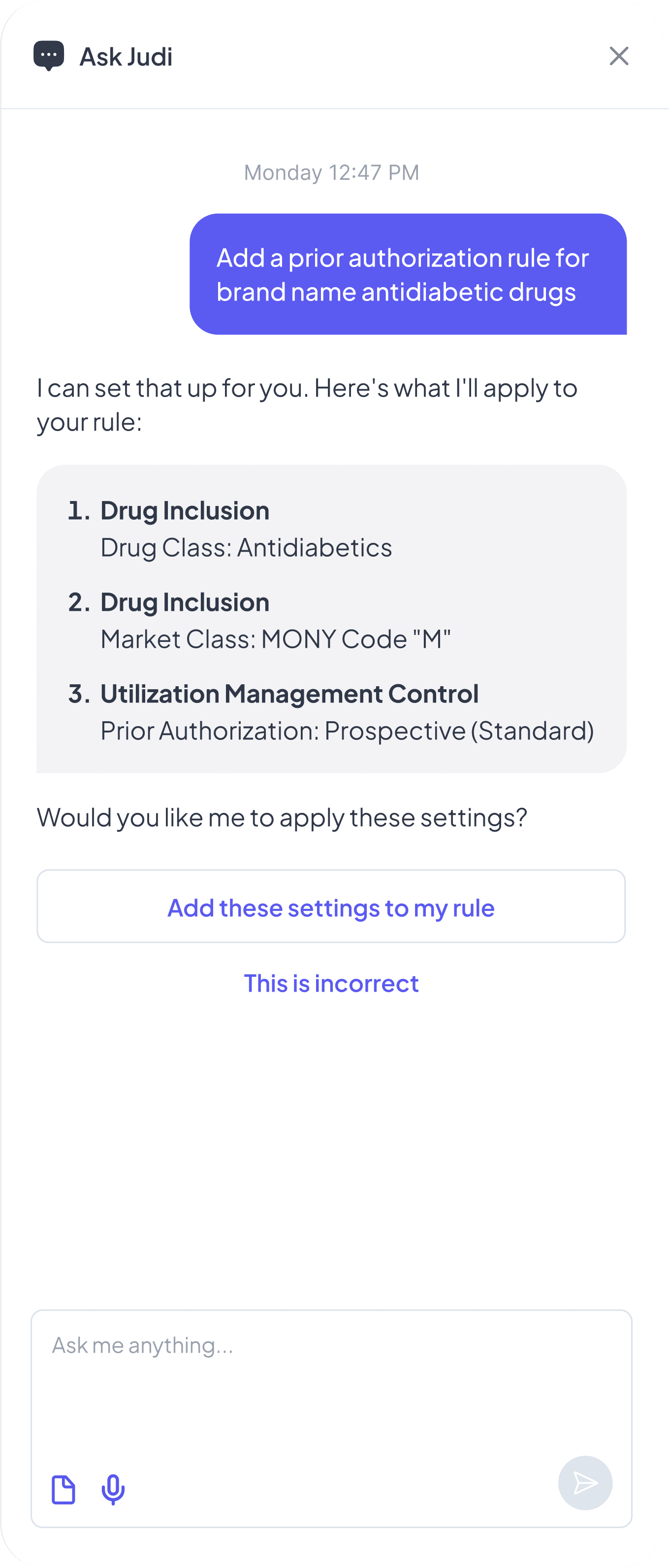

Keeping Pharmacists in Control


Supporting Exploratory Work


Traditional usability metrics captured only part of the experience. Success also depended on whether the assistant reduced disruption while helping pharmacists feel informed and in control.
We evaluated:
Time required to retrieve drug information
Number of external searches per task
Frequency of context switching
Completion time for complex rule-configuration tasks
Perceived usefulness
User confidence
Trust in AI-supported information
The initial release focused on information retrieval, where AI could provide clear value without overstepping pharmacist judgment.
Future concepts explored how the assistant could support additional stages of the formulary lifecycle, including:
Suggested affected drugs
Draft rule recommendations
Duplicate-rule detection
Conflict identification
Peer-review summaries
Reviewer recommendations
Publication validation
These concepts would require additional safeguards, validation, and pharmacist oversight. Rather than introducing them as isolated AI features, the long-term vision positions the assistant as a collaborative layer across rule authoring, review, and publication.
Potential future outcomes include:
30–40% reduction in rule-authoring time
Fewer duplicate or conflicting rules
Reduced support requests
Faster onboarding for new pharmacists
Greater consistency across formularies
Designing AI for healthcare required resisting the temptation to automate everything.
The most meaningful challenge was not creating another chatbot. It was identifying where AI could improve an expert workflow, defining where it should stop, and giving users enough transparency and control to decide when its information was useful.
This project strengthened my approach to human-centered AI design and reinforced a principle that continues to guide my work: Successful AI products are built around trust, context, and thoughtful interaction design—not intelligence alone.