Grubhub
Unlocking $20M in Annual Revenue With Self-Service Ads
Role: Senior Product Designer
Timeline: 2 months
Team: Product Manager, Engineers, Content Design, Sales, Legal
Responsibilities: Product Strategy, UX Research, Experience Mapping, Interaction Design, Prototyping, Data Visualization, Design Systems
Grubhub
Unlocking $20M in Annual Revenue With Self-Service Ads
Role: Senior Product Designer
Timeline: 2 months
Team: Product Manager, Engineers, Content Design, Sales, Legal
Responsibilities: Product Strategy, UX Research, Experience Mapping, Interaction Design, Prototyping, Data Visualization, Design Systems

Overview
Overview
Grubhub wanted to help restaurant partners reach more diners while creating a scalable new revenue stream for the business.Sponsored advertising offered that opportunity, but existing advertising experiences were too complex and opaque for many restaurant owners to navigate without marketing expertise.
I led the end-to-end experience design for Sponsored Ads, a self-service campaign platform within Grubhub for Restaurants that enabled merchants to create, manage, and measure targeted advertising campaigns directly from their dashboard.
The challenge was not simply to expose more advertising controls. It was to translate the complexity of ad targeting, bidding, scheduling, and performance measurement into an experience that felt approachable to a busy restaurant operator.
The Opportunity
The Opportunity
Restaurant owners wanted more ways to increase their visibility on Grubhub, but digital advertising introduced a significant knowledge barrier.
Concepts like audience targeting, campaign duration, budgets, conversion rates, and return on ad spend are familiar to marketers—but not necessarily to someone managing restaurant operations.
At the same time, oversimplifying the experience could limit campaign effectiveness and reduce merchants' sense of control.
The design challenge became:
How might we make sophisticated advertising capabilities accessible to merchants without requiring advertising expertise?
How might we make sophisticated advertising capabilities accessible to merchants without requiring advertising expertise?
Research & Discovery
Research & Discovery
To understand what merchants needed to feel confident spending, I leveraged interviews and market research to understand how restaurant partners thought about advertising and where they needed additional guidance.
Rather than thinking in traditional advertising terminology, merchants tended to frame campaigns around practical business goals:
Who do I want to reach?
New customers, returning customers, or Grubhub+ members.
When do I need more orders?
Specific days, slower periods, or peak ordering windows.
How much am I comfortable spending?
A predictable monthly budget they could adjust as needed.
Research also surfaced a strong need for visibility into what merchants were purchasing before they committed. These findings helped us move away from exposing advertising mechanics and instead organize the experience around decisions merchants already understood.
90%
90%
Wanted the ability to target specific types of diners
Wanted the ability to target specific types of diners
56%
56%
Saw flexibility in scheduling and spend as a top priority
Saw flexibility in scheduling and spend as a top priority
65%
65%
Considered previewing their ad experience important for trust
Considered previewing their ad experience important for trust
Design Strategy
Design Strategy
Success meant balancing four competing needs:
Simplicity
Reduce the knowledge and effort required to launch a campaign.
Control
Give merchants meaningful influence over audience, timing, and spend.
Transparency
Make ad placement, cost, and performance easier to understand.
Scalability
Establish a framework that could support future advertising products and campaign types.
Mapping the Journey
Mapping the
Journey
I mapped the end-to-end journey of ad creation and introduced a dedicated Ads destination within the Grubhub for Restaurants platform, establishing a scalable home for campaign creation, management, and performance insights rather than treating advertising as a one-off promotional feature.
One of the key design decisions was determining how much control to expose without overwhelming users. Rather than recreating the complexity of a traditional advertising platform, I focused campaign creation around four decisions:
Audience: Which types of diners should see the ad?
Schedule: When should the campaign run?
Timing: Which days or ordering periods should be prioritized?
Budget: How much should the merchant spend each month?
This framework gave merchants meaningful control while keeping the underlying advertising infrastructure largely invisible.

Exploring Directions
Exploring Directions
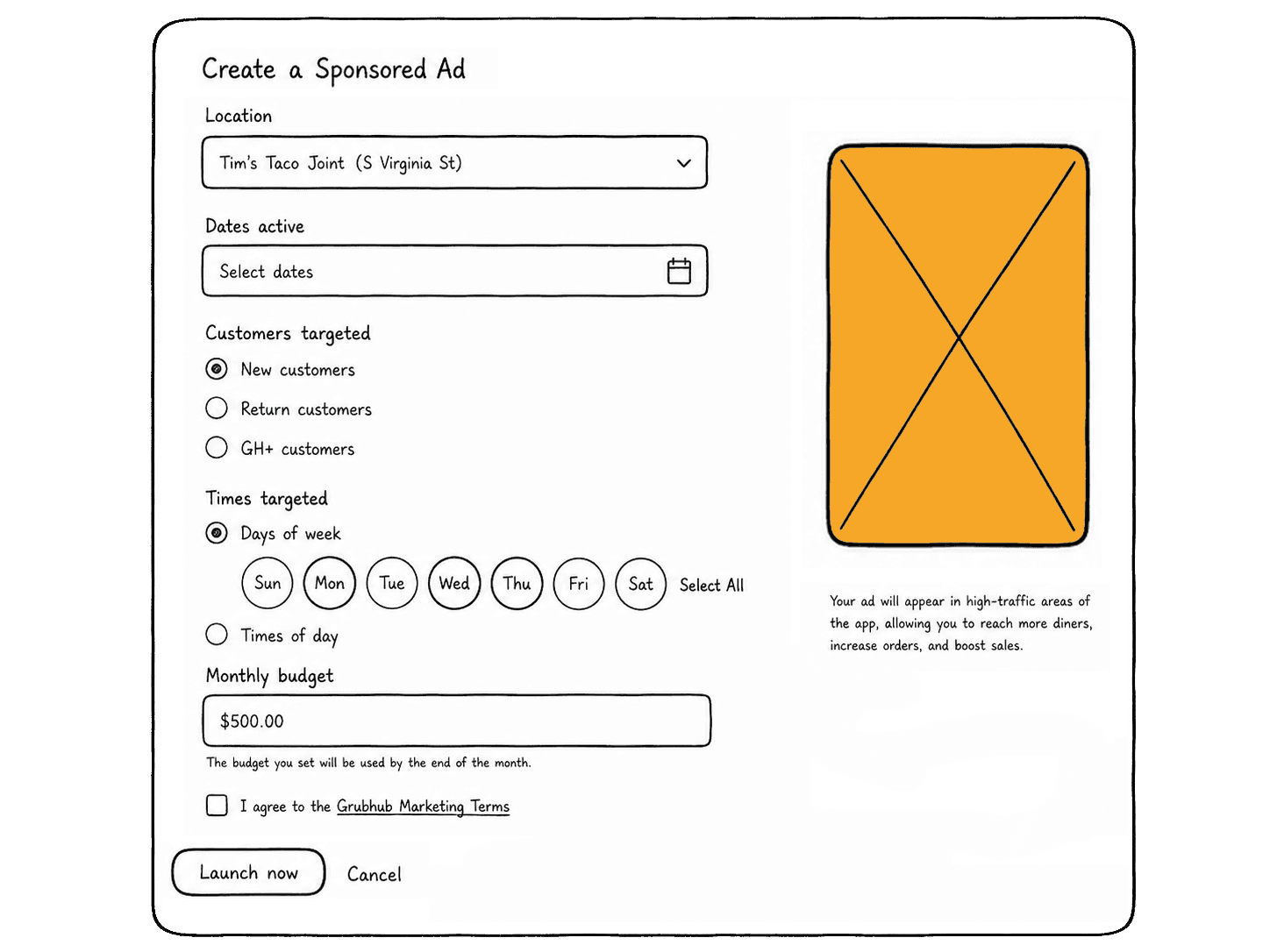
Early exploration included both multi-step and single-page campaign creation patterns. Competitive advertising platforms frequently divided campaign setup across several screens. While this created space for more advanced configuration, it also increased navigation and made it harder for merchants to understand the full scope of their campaign before launching.
I designed a streamlined single-page creation experience that allowed merchants to configure and review their entire campaign in one place.
This approach:
Reduced navigation and setup friction
Made campaign parameters easier to compare
Allowed users to understand the full campaign before committing
Created clearer relationships between targeting decisions and ad previews
Made the experience feel closer to configuring a promotion than operating an advertising platform

The Solution
The Solution
A Clear Entry Point
A Clear Entry Point
I introduced a dedicated Sponsored Ads landing experience within the merchant portal.
Instead of immediately presenting merchants with campaign configuration fields, the page first explained the value of Sponsored Ads, where ads could appear, and how they could help restaurants reach additional diners.
Visual examples of ad placements made an otherwise abstract product more tangible and helped merchants understand what they were purchasing before committing budget.

Guided Campaign Creation
Guided Campaign Creation
The campaign builder reduced advertising setup to a concise set of merchant-friendly controls.
Merchants could customize:
Campaign start and end dates
Target customer segments
Days and times
Monthly budget
A live visual preview reinforced how the restaurant would appear to diners as merchants configured their campaign.
The design intentionally used progressive complexity: sensible defaults made it possible to launch quickly, while additional controls gave merchants flexibility when they wanted it.
This allowed the same experience to support both first-time advertisers and merchants looking for more control over campaign performance.


Performance Insights
Performance Insights
Launching a campaign was only one part of the experience. Merchants also needed to understand whether their investment was working.
I designed a centralized campaign management and insights experience where merchants could review active and historical campaigns and quickly assess performance.
The dashboard surfaced metrics including:
Ad-attributed sales
Impressions
Clicks
Conversion rate
Cost per click
Return on ad spend
Trend indicators and visualizations helped translate raw advertising data into information merchants could act on, while campaign history enabled them to learn from previous campaigns and make more informed decisions about future spend.
This transformed Sponsored Ads from a one-time campaign builder into an ongoing optimization loop:
Create → Measure → Learn → Adjust → Relaunch

Designing for Scale
Designing for Scale
A key part of my role was designing beyond the immediate MVP.
The architecture needed to accommodate additional advertising formats, targeting options, campaign states, and performance metrics without requiring the experience to be rebuilt as the product matured.
I partnered closely with Product and Engineering to distinguish what merchants needed for the initial release from functionality that could be layered into the product over time.
By creating reusable campaign configuration patterns and a dedicated advertising management framework, we established a foundation Grubhub could continue expanding beyond the initial Sponsored Ads offering.
Impacts
Impacts
Sponsored Ads demonstrated that sophisticated advertising tools could be made accessible to restaurant operators without stripping away the controls that made campaigns valuable.
The product created value on both sides of Grubhub's marketplace: merchants gained a new way to reach customers and increase orders, while Grubhub established a scalable new monetization channel.
$10–20M/yr
$10–20M/yr
In revenue opportunity for Grubhub
In revenue opportunity for Grubhub
$9K/day
$9K/day
In revenue for Grubhub after launch
In revenue for Grubhub after launch
30% more orders
30% more orders
Participating merchants saw meaningful order growth, including orders from new customers
Participating merchants saw meaningful order growth, including orders from new customers
6x Return on Ad Spend
6x ROAS
6x ROAS
Merchants generated approximately $6 in return for every $1 invested in ads
Merchants generated approximately $6 in return for every $1 invested in ads
Reflection
Reflection
The most important design challenge wasn't creating an advertising interface—it was deciding which parts of a sophisticated advertising system merchants actually needed to understand.
By reframing campaign setup around familiar business decisions—who to reach, when to advertise, and how much to spend—we were able to give merchants meaningful control without forcing them to become marketers.
The project reinforced a principle I continue to use when designing complex SaaS products: simplicity isn't removing functionality. It's exposing the right complexity at the right time.
Grubhub
Grubhub
Increasing onboarding conversion by 150%
Unlocking $20M in Annual Revenue With Self-Service Ads
Role: Senior Product Designer
Timeline: 6 months
Team: Product Manager, Engineers, Copy, Sales
Responsibilities: Product strategy, AI interaction design, UX research, conversation design, prototyping, usability testing, developer collaboration and handoff
Role: Senior Product Designer
Timeline: 2 months
Team: Product Manager, Engineers, Copy, Sales, Legal
Responsibilities: Product Strategy, UX Research, Experience Mapping, Interaction Design, Prototyping, Data Visualization, Design Systems
Grubhub
Unlocking $20M in Annual Revenue With Self-Service Ads
Role: Senior Product Designer
Timeline: 2 months
Team: Product Manager, Engineers, Copy, Sales, Legal
Responsibilities: Product Strategy, UX Research, Experience Mapping, Interaction Design, Prototyping, Data Visualization, Design Systems
Overview
Grubhub wanted to help restaurant partners reach more diners while creating a scalable new revenue stream for the business.Sponsored advertising offered that opportunity, but existing advertising experiences were too complex and opaque for many restaurant owners to navigate without marketing expertise.
I led the end-to-end experience design for Sponsored Ads, a self-service campaign platform within Grubhub for Restaurants that enabled merchants to create, manage, and measure targeted advertising campaigns directly from their dashboard.
The challenge was not simply to expose more advertising controls. It was to translate the complexity of ad targeting, bidding, scheduling, and performance measurement into an experience that felt approachable to a busy restaurant operator.
Research & Discovery
To understand what merchants needed to feel confident spending, I leveraged interviews and market research to understand how restaurant partners thought about advertising and where they needed additional guidance.
Rather than thinking in traditional advertising terminology, merchants tended to frame campaigns around practical business goals:
Who do I want to reach?
New customers, returning customers, or Grubhub+ members.
When do I need more orders?
Specific days, slower periods, or peak ordering windows.
How much am I comfortable spending?
A predictable monthly budget they could adjust as needed.
Research also surfaced a strong need for visibility into what merchants were purchasing before they committed. These findings helped us move away from exposing advertising mechanics and instead organize the experience around decisions merchants already understood.
90%
Wanted the ability to target specific types of diners
56%
Saw flexibility in scheduling and spend as a top priority
65%
Considered previewing their ad experience important for trust
Mapping the Journey
I mapped the end-to-end journey of ad creation and introduced a dedicated Ads destination within the Grubhub for Restaurants platform, establishing a scalable home for campaign creation, management, and performance insights rather than treating advertising as a one-off promotional feature.
One of the key design decisions was determining how much control to expose without overwhelming users. Rather than recreating the complexity of a traditional advertising platform, I focused campaign creation around four decisions:
Audience: Which types of diners should see the ad?
Schedule: When should the campaign run?
Timing: Which days or ordering periods should be prioritized?
Budget: How much should the merchant spend each month?
This framework gave merchants meaningful control while keeping the underlying advertising infrastructure largely invisible.
Exploring Directions
Early exploration included both multi-step and single-page campaign creation patterns. Competitive advertising platforms frequently divided campaign setup across several screens. While this created space for more advanced configuration, it also increased navigation and made it harder for merchants to understand the full scope of their campaign before launching.
I designed a streamlined single-page creation experience that allowed merchants to configure and review their entire campaign in one place.
This approach:
Reduced navigation and setup friction
Made campaign parameters easier to compare
Allowed users to understand the full campaign before committing
Created clearer relationships between targeting decisions and ad previews
Made the experience feel closer to configuring a promotion than operating an advertising platform
The New Experience
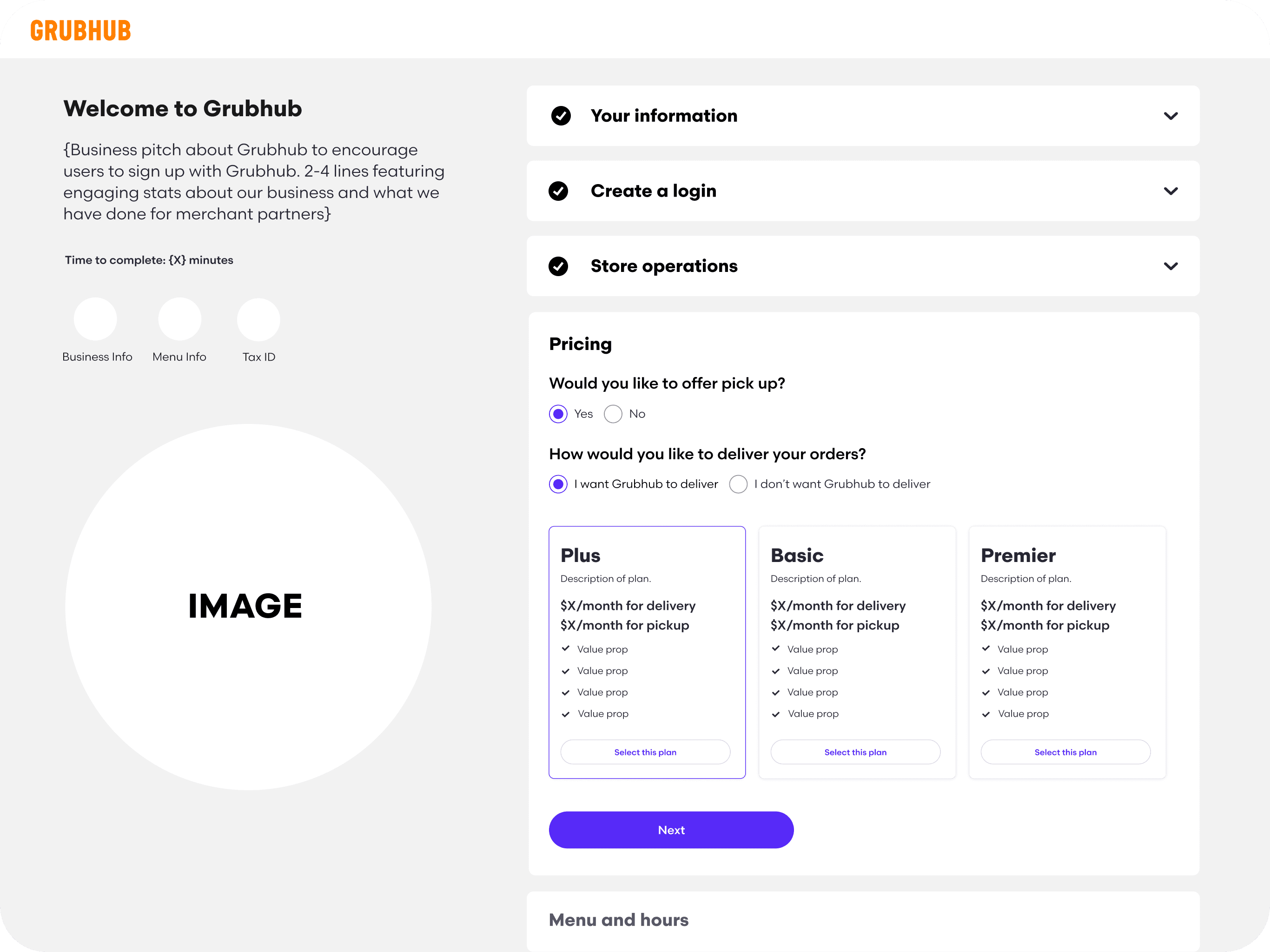
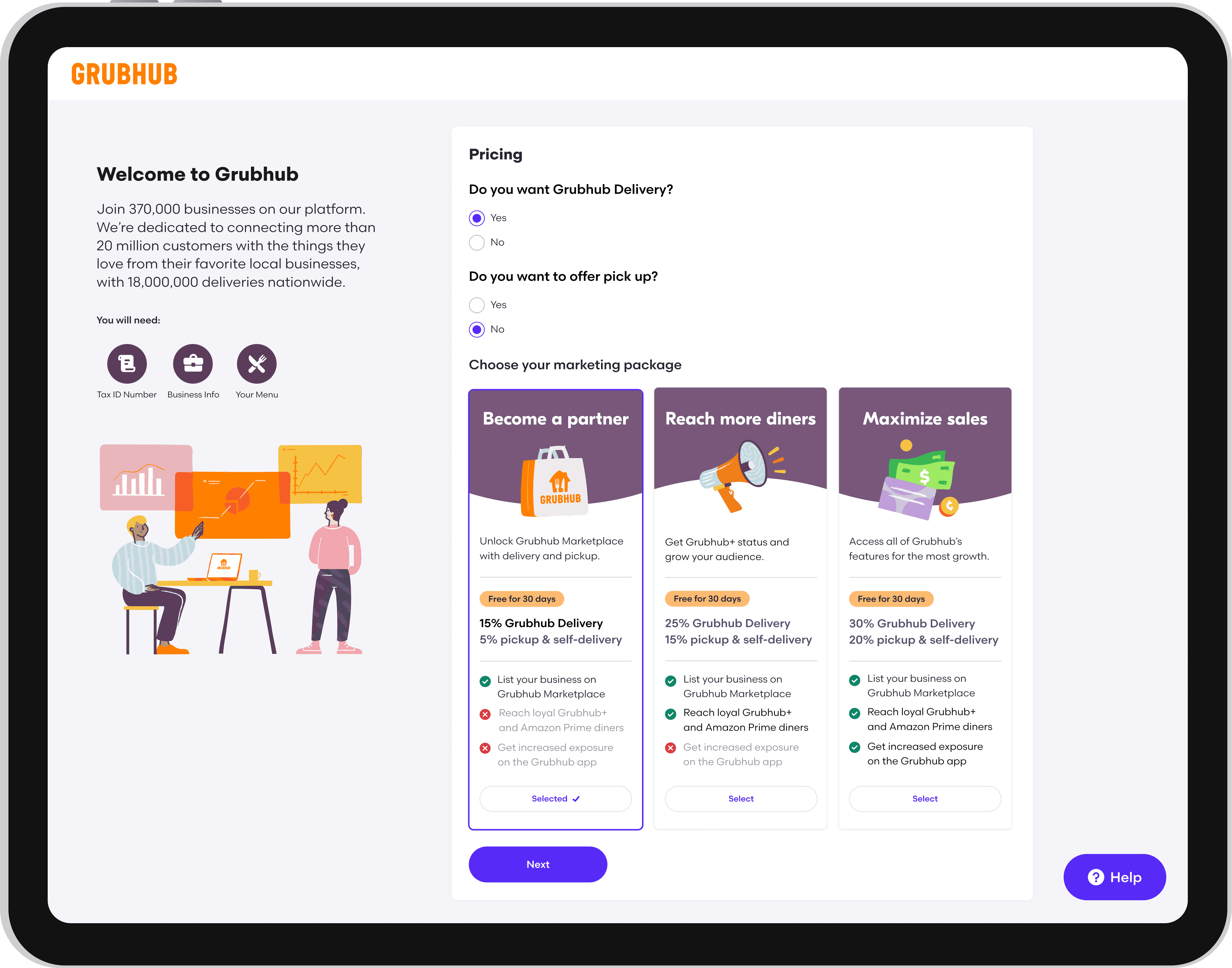
I redesigned pricing around three outcome-oriented plans:
Become a Partner
Reach More Diners
Maximize Sales
Each option included a scannable comparison of features, exclusions, fees, and expected value. A 30-day free trial reduced the perceived risk of selecting a plan.
Rather than presenting pricing as an isolated transactional decision, the experience connected each plan to the merchant’s business goals.
Transparent Plan Selection
Upfront Requirements
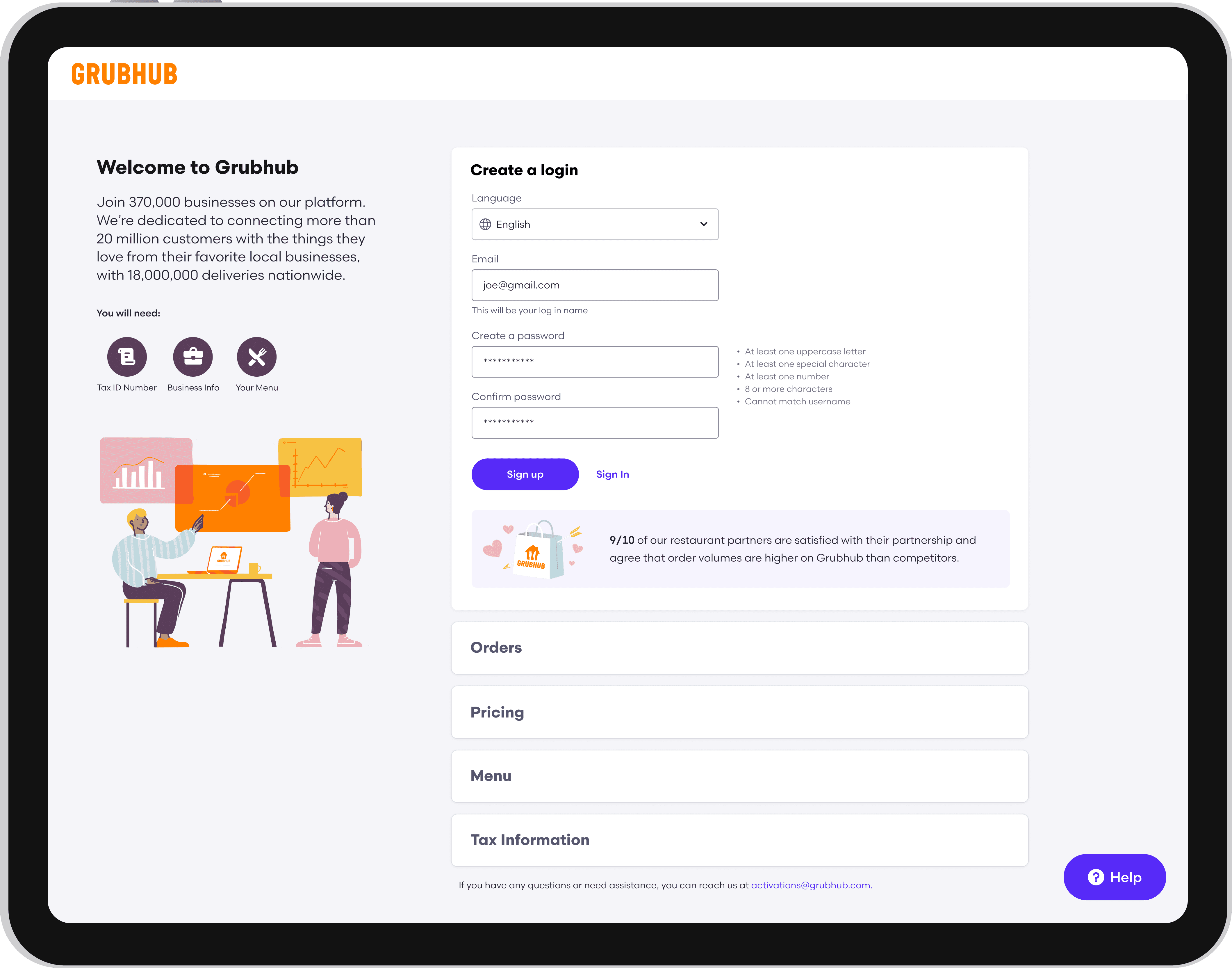
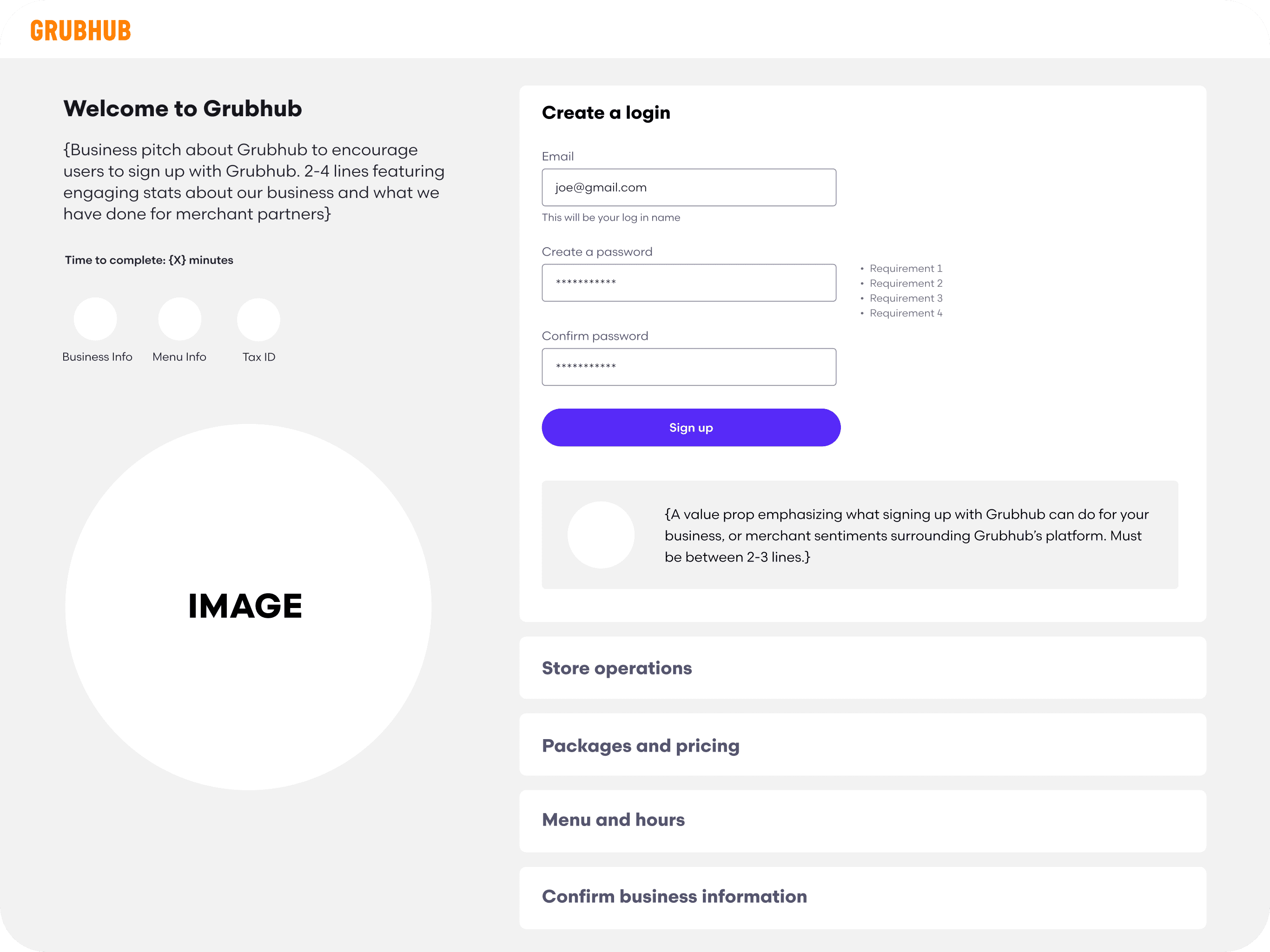
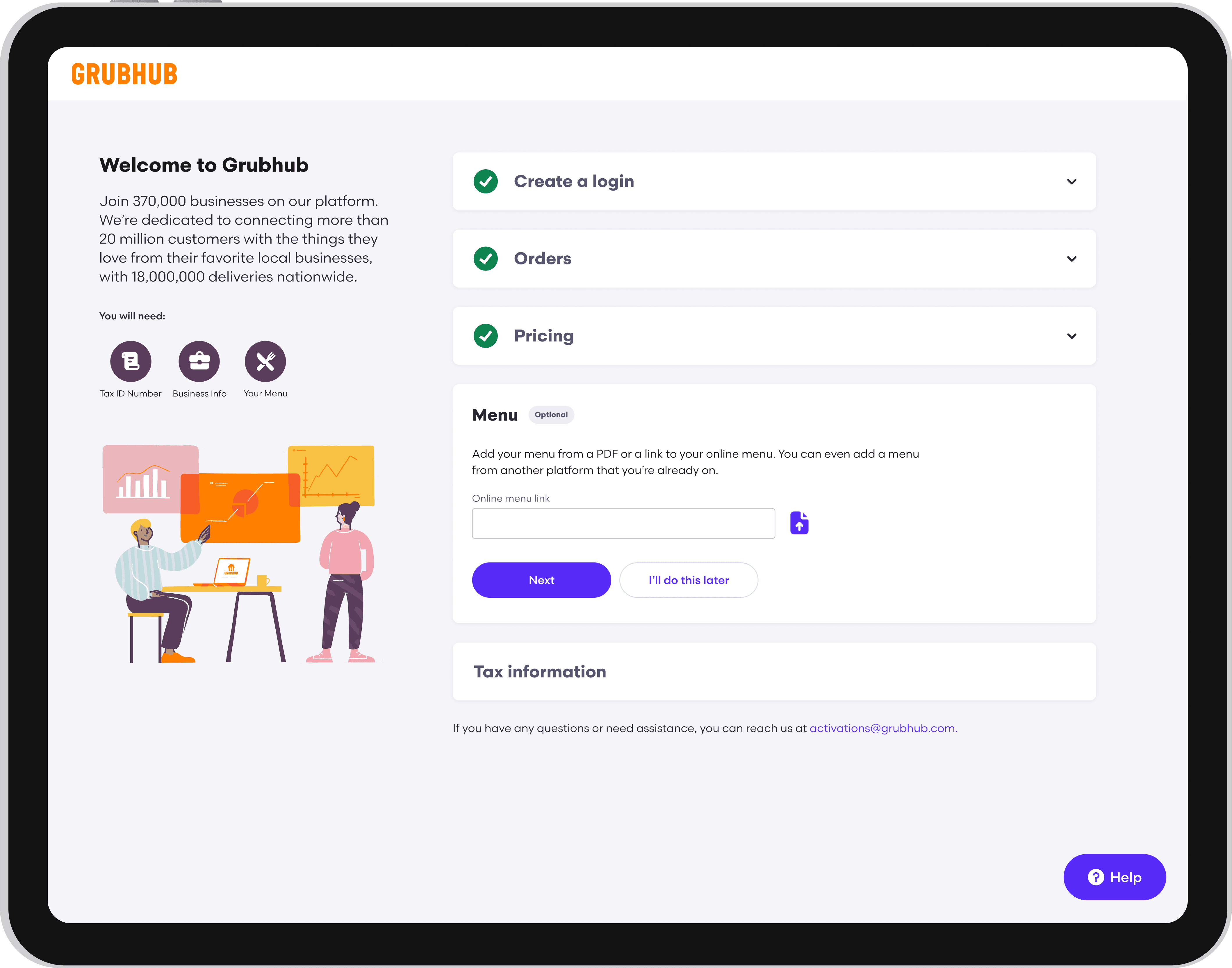
Before beginning, merchants received a clear overview of:
Expected completion time
Information and documents they would need
Required and optional sections
What would happen after submission
This helped merchants prepare before entering the flow and reduced unexpected interruptions.Rather than presenting pricing as an isolated transactional decision, the experience connected each plan to the merchant’s business goals.
Flexible Completion
Nonessential steps could be skipped and completed later within Grubhub for Restaurants.
This allowed merchants to make progress even when they did not have every piece of information available, while preserving the requirements necessary to activate their account.
Multilingual Onboarding
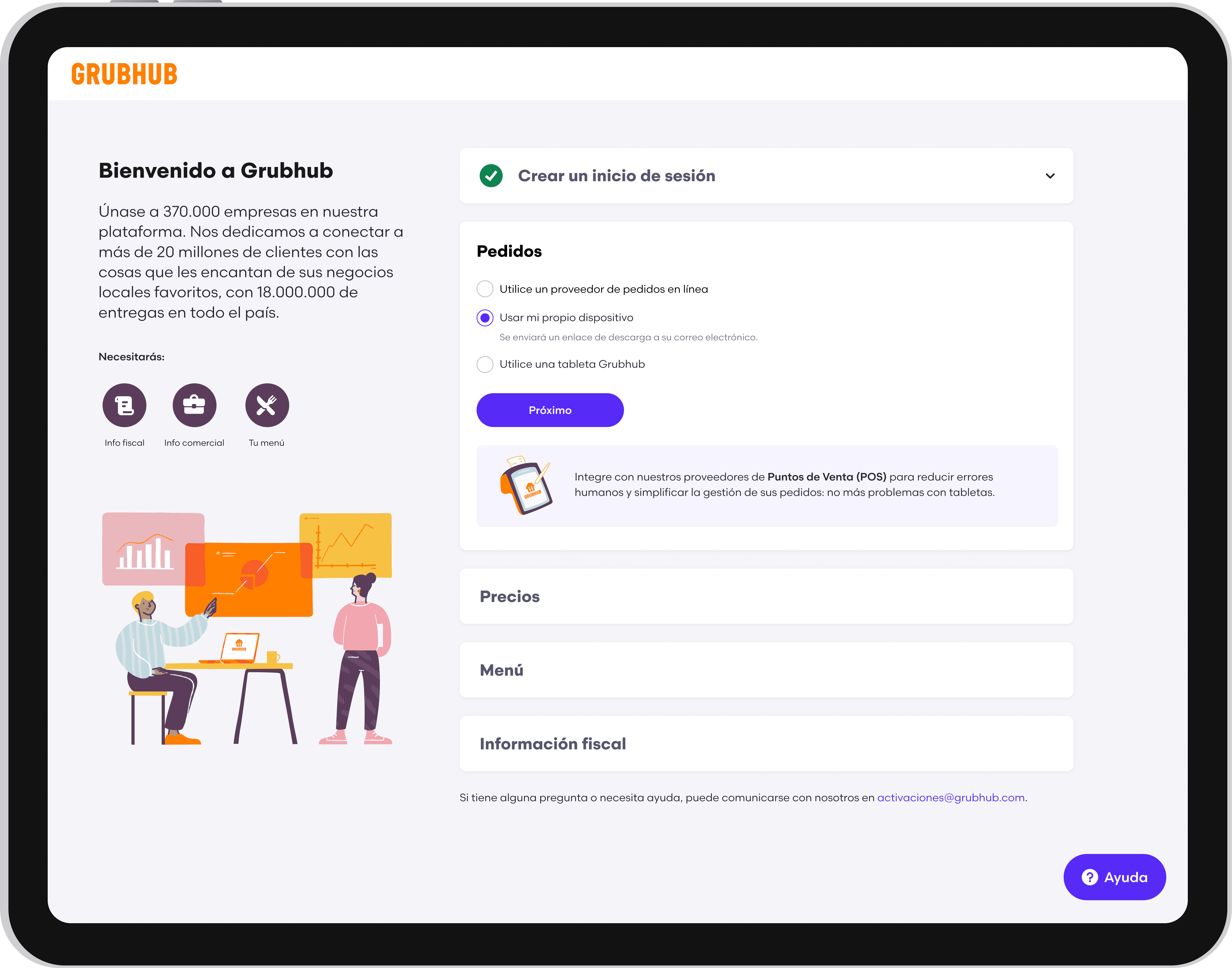
Merchants could select their preferred language from the initial signup page, translating the full onboarding experience into the languages most commonly used by Grubhub’s merchant community.
Translation was integrated into the experience architecture rather than added as a page-level workaround, creating a consistent journey from signup through completion.
AI Guidance
I designed GrubBot, an AI-assisted onboarding companion that provided contextual support without requiring merchants to leave the flow.
GrubBot could:
Explain unfamiliar requirements
Answer frequently asked questions
Clarify terminology
Direct merchants to the appropriate section
Provide structured prompts based on where they were in the process
To make the assistant predictable and trustworthy, I designed clear entry points, constrained response paths, and contextual recommendations rather than relying solely on an open-ended chat interface.
The interaction model was refined through iterative testing to ensure that AI assistance complemented the core experience instead of becoming another layer merchants had to understand.

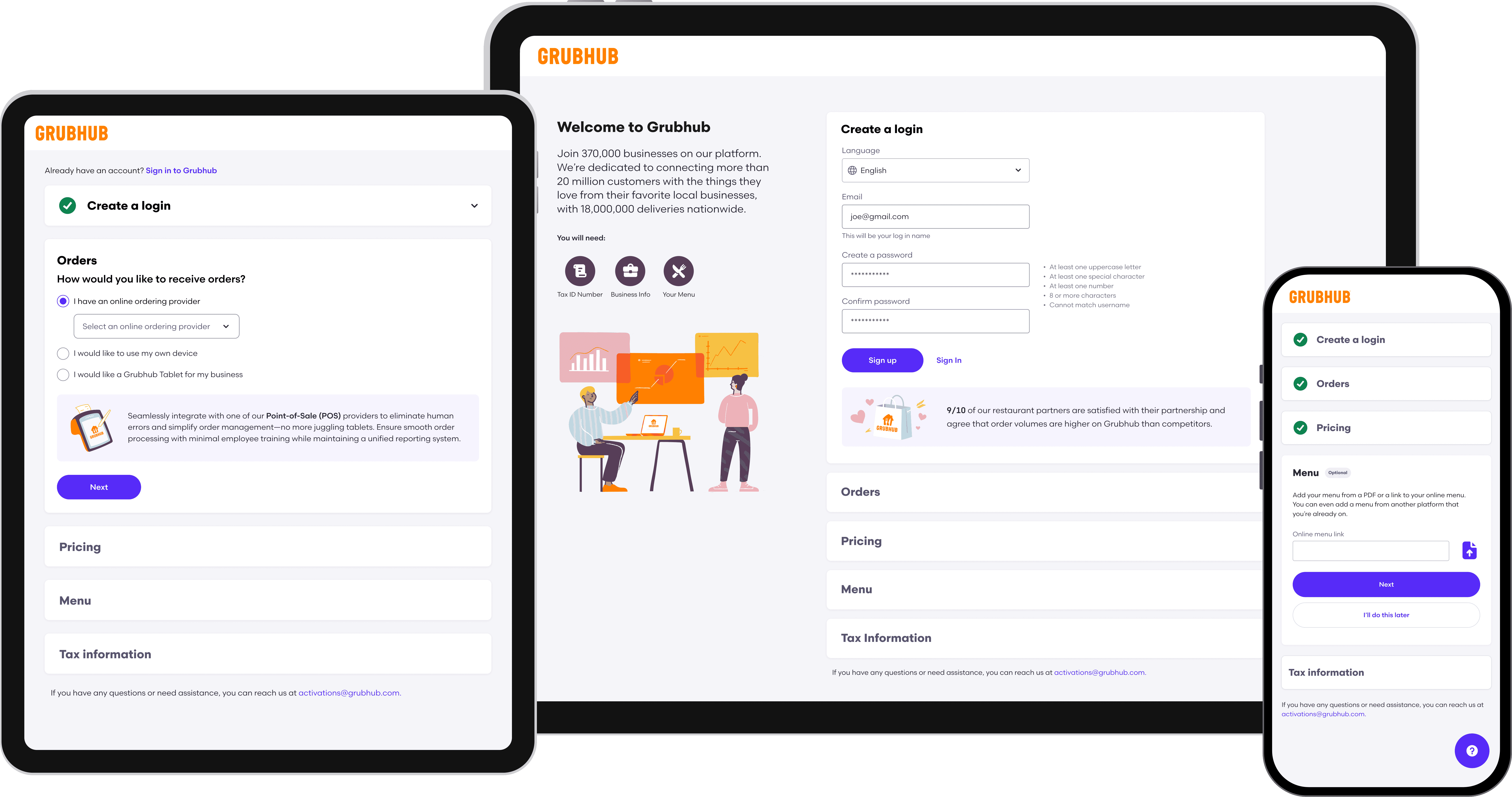
Responsive Access
The redesigned flow supported desktop, tablet, and mobile devices. This was particularly important for restaurant operators, who often manage their businesses away from a desk and may need to complete onboarding between operational tasks.
Responsive layouts preserved hierarchy, progress visibility, and editing functionality across screen sizes.
Design Strategy
Success meant balancing four competing needs:
Simplicity
Reduce the knowledge and effort required to launch a campaign.
Control
Give merchants meaningful influence over audience, timing, and spend.
Transparency
Make ad placement, cost, and performance easier to understand.
Scalability
Establish a framework that could support future advertising products and campaign types.
Impacts
Sponsored Ads demonstrated that sophisticated advertising tools could be made accessible to restaurant operators without stripping away the controls that made campaigns valuable.
The product created value on both sides of Grubhub's marketplace: merchants gained a new way to reach customers and increase orders, while Grubhub established a scalable new monetization channel.
$10–20M/yr
In revenue opportunity for Grubhub
$9K/day
In revenue for Grubhub after launch
30% more orders
Participating merchants saw meaningful order growth, including orders from new customers
6x Return on Ad Spend
Merchants generated approximately $6 in return for every $1 invested in ads
$10–20M annual revenue opportunity
Sponsored Ads opened a significant new revenue channel for Grubhub.
$9K in daily revenue after launch
Early adoption demonstrated immediate merchant demand for the product.
30% increase in monthly orders
Participating merchants saw meaningful order growth, including orders from new customers.
6x average Return on Ad Spend (ROAS)
Merchants generated approximately $6 in return for every $1 invested in Sponsored Ads.
Reflection
The most important design challenge wasn't creating an advertising interface—it was deciding which parts of a sophisticated advertising system merchants actually needed to understand.
By reframing campaign setup around familiar business decisions—who to reach, when to advertise, and how much to spend—we were able to give merchants meaningful control without forcing them to become marketers.
The project reinforced a principle I continue to use when designing complex SaaS products: simplicity isn't removing functionality. It's exposing the right complexity at the right time.
The Solution
The campaign builder reduced advertising setup to a concise set of merchant-friendly controls.
Merchants could customize:
Campaign start and end dates
Target customer segments
Days and times
Monthly budget
A live visual preview reinforced how the restaurant would appear to diners as merchants configured their campaign.
The design intentionally used progressive complexity: sensible defaults made it possible to launch quickly, while additional controls gave merchants flexibility when they wanted it.
This allowed the same experience to support both first-time advertisers and merchants looking for more control over campaign performance.
Guided Campaign Creation
A Clear Entry Point
I introduced a dedicated Sponsored Ads landing experience within the merchant portal.
Instead of immediately presenting merchants with campaign configuration fields, the page first explained the value of Sponsored Ads, where ads could appear, and how they could help restaurants reach additional diners.
Visual examples of ad placements made an otherwise abstract product more tangible and helped merchants understand what they were purchasing before committing budget.
Performance Insights
Launching a campaign was only one part of the experience. Merchants also needed to understand whether their investment was working.
I designed a centralized campaign management and insights experience where merchants could review active and historical campaigns and quickly assess performance.
The dashboard surfaced metrics including:
Ad-attributed sales
Impressions
Clicks
Conversion rate
Cost per click
Return on ad spend
Trend indicators and visualizations helped translate raw advertising data into information merchants could act on, while campaign history enabled them to learn from previous campaigns and make more informed decisions about future spend.
This transformed Sponsored Ads from a one-time campaign builder into an ongoing optimization loop:
Create → Measure → Learn → Adjust → Relaunch
Designing for Scale
A key part of my role was designing beyond the immediate MVP.
The architecture needed to accommodate additional advertising formats, targeting options, campaign states, and performance metrics without requiring the experience to be rebuilt as the product matured.
I partnered closely with Product and Engineering to distinguish what merchants needed for the initial release from functionality that could be layered into the product over time.
By creating reusable campaign configuration patterns and a dedicated advertising management framework, we established a foundation Grubhub could continue expanding beyond the initial Sponsored Ads offering.
The Opportunity
Restaurant owners wanted more ways to increase their visibility on Grubhub, but digital advertising introduced a significant knowledge barrier.
Concepts like audience targeting, campaign duration, budgets, conversion rates, and return on ad spend are familiar to marketers—but not necessarily to someone managing restaurant operations.
At the same time, oversimplifying the experience could limit campaign effectiveness and reduce merchants' sense of control.
The design challenge became:
How might we make sophisticated advertising capabilities accessible to merchants without requiring advertising expertise?